Traditional vs Roth: Which Should You Choose?
Educational content only. This article is for informational purposes and does not constitute personalized financial, tax, or investment advice. Consult a qualified professional for guidance specific to your situation.
TL;DR
- Simple bracket rule: 10–12% → Roth; 32%+ → Traditional; 22–24% → blend (tilted toward Roth)
- Future taxes likely higher: Rates are at historic lows — lean Roth if you're under 50 and uncertain
- Blend is often ideal: Having both Traditional and Roth gives you flexibility to optimize withdrawals in retirement
How to allocate between a Traditional and Roth 401K?
If you're reading this page, I assume that your employer offers both a Traditional 401K and Roth 401K. If that's the case, before you read on, I recommend that you quickly read this page on which order to contribute to accounts to minimize future taxes - it'll give you a better handle on what'll be mentioned here.
The biggest drivers in deciding whether to contribute to a Traditional 401K or Roth 401K will be your income / current marginal tax rate and anticipated future marginal tax rate.
Income and marginal tax bracket
Your income determines your marginal tax bracket. If you're in a low marginal tax bracket, you'll want to steer more toward the Roth 401K (post-tax), and if you're in a high marginal tax bracket, you'll want to steer toward the Traditional 401K to take the up-front tax deduction.
Caveat: In retirement (assuming that you don't have major passive income sources), your income will always start in the lowest tax bracket, and you will want to ensure you have some funds in a pre-tax account so that you can start withdrawing at the lowest tax bracket first.
2025 Federal marginal tax brackets by filing status and income:
| Federal marginal tax rate | Single | Married, filing jointly | DIYFi recommendation |
|---|---|---|---|
| 10% | $0 – $11,925 | $0 – $23,850 | Roth |
| 12% | $11,926 – $48,475 | $23,851 – $96,950 | Roth |
| 22% | $48,476 – $103,350 | $96,951 – $206,700 | Blend, tilted Roth |
| 24% | $103,351 – $197,300 | $206,701 – $394,600 | Blend, tilted Trad. |
| 32% | $197,301 – $250,525 | $394,601 – $501,050 | Traditional |
| 35% | $250,526 – $626,350 | $501,051 – $751,600 | Traditional |
| 37% | $626,351+ | $751,601+ | Traditional |
Anticipated future marginal tax rate
This is a tricky exercise: your future marginal tax rate is hard to predict, both because the government can revise the tax code and it's hard to estimate how much you'll spend in retirement per year. But as the figure below shows, we currently live in an era of low taxes - and given where the U.S.'s national debt is at, I suspect that tax rates will climb even after adjusting for inflation.
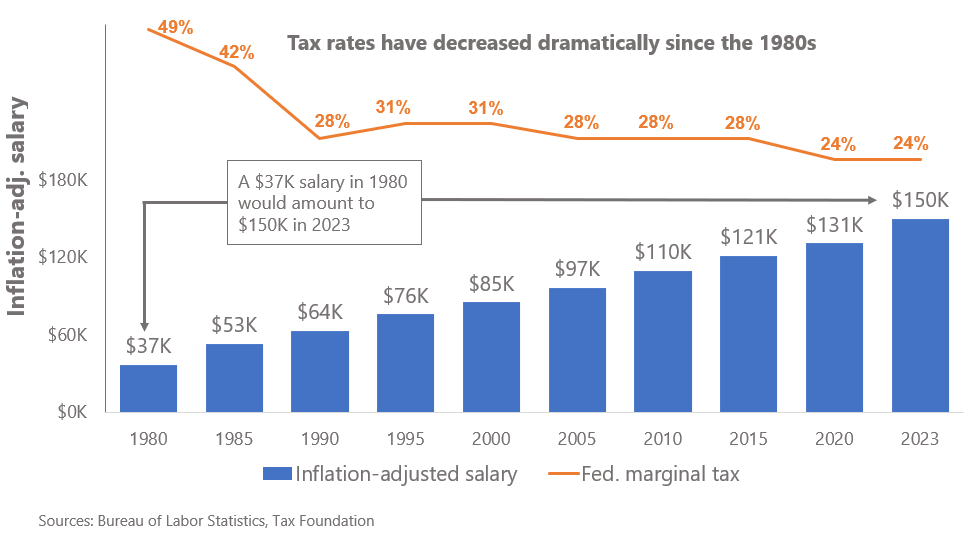
Sources: Bureau of Labor Statistics, Tax Foundation
If you expect your spending in retirement to be high - at or above the income levels for the 24% bracket, I would heavily consider pushing more money toward the Roth 401K to hedge against future tax increases.
Key considerations in your decision
Traditional 401K advantages
- •Immediate tax savings (particularly valuable in high tax brackets)
- •More money invested upfront (since you're not paying taxes first)
- •Lower AGI may qualify you for other tax benefits
- •Withdrawals can be optimized to lower tax brackets in retirement
Roth 401K advantages
- •Tax-free growth and withdrawals in retirement
- •Protection against future tax rate increases
- •No required minimum distributions (if rolled to Roth IRA)
- •Effectively allows you to save more (since contributions are post-tax)
The "Blend" Approach
A smart strategy for many investors is to build both Traditional and Roth accounts. This gives you tax diversification and flexibility in retirement, allowing you to:
- •Withdraw from Traditional accounts up to lower tax brackets
- •Use Roth withdrawals for additional needs without increasing your tax bracket
- •Adjust your strategy based on changing tax laws
Try it yourself
Retirement Projection Calculator
Project where your savings could land at retirement and whether you are on track.
Enjoyed this? Get the next one in your inbox.
New DIYFi guides and calculators, straight from the DIYFi newsletter. Free, no spam, unsubscribe anytime.
Not sure how to split between Traditional and Roth given your income? Book a free 15-min call.
Next up
What to Invest In